
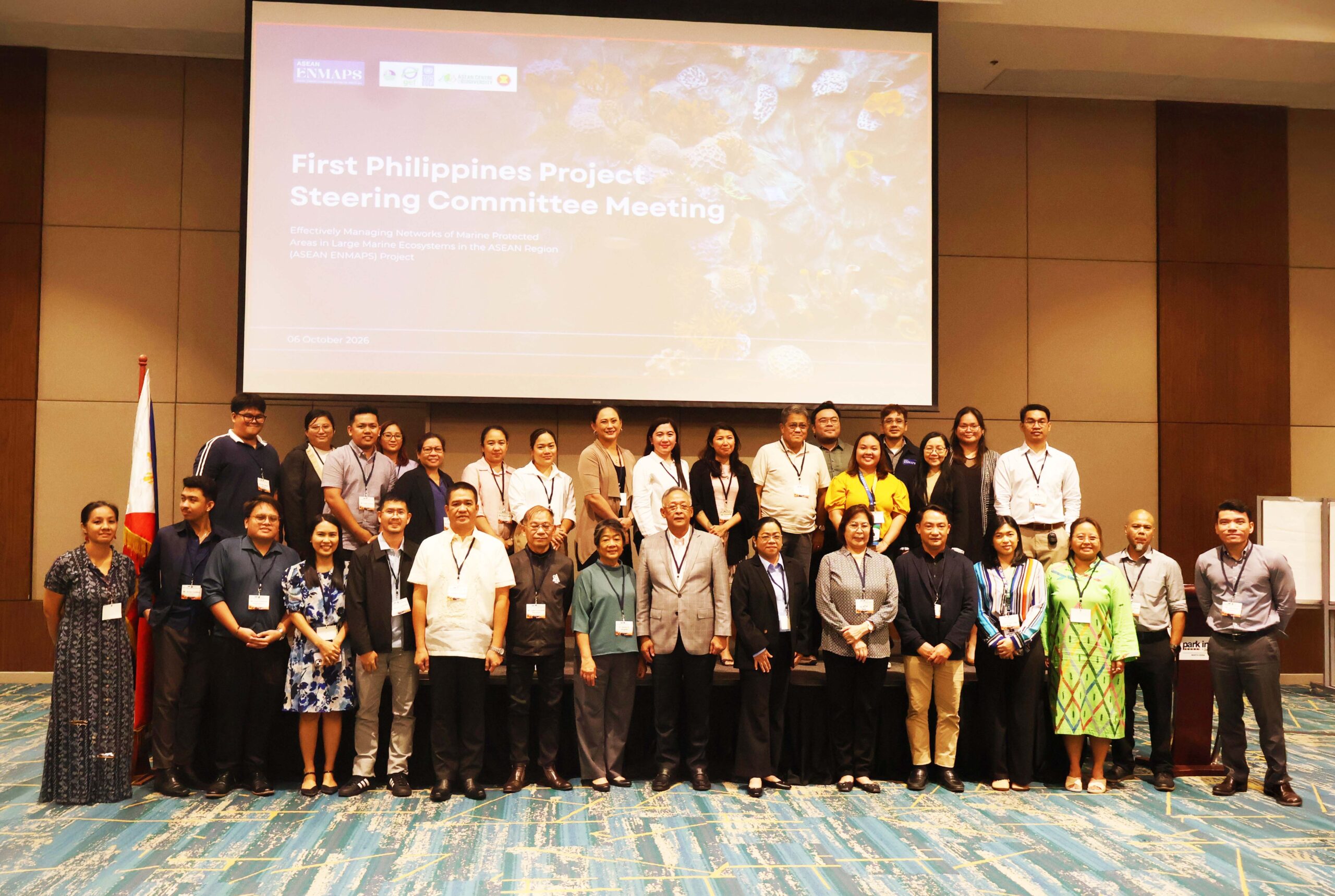
QUEZON CITY, Philippines – The ASEAN Centre for Biodiversity (ACB), in partnership with the Department of Environment and Natural Resources (DENR) of the Philippines and the United Nations Development Programme (UNDP), advances the implementation of the Effectively Managing Networks of Marine Protected Areas in Large Marine Ecosystems in the ASEAN Region (ASEAN ENMAPS) Project in the Philippines through a three-day national mobilisation from 6 to 8 October 2026.
The three-day mobilisation brought together national government agencies, development partners, technical experts, and representatives from the project’s five Philippine sites to establish the governance, implementation, safeguards, and stakeholder engagement foundations for the project. These activities marked an important step in translating the regional objectives of ASEAN ENMAPS into coordinated national and site-level implementation in the Philippines.
Strengthening governance and coordination
It began with the First Philippine Project Steering Committee (PPSC) Meeting on 6 October, which formally convened the national governance mechanism for ASEAN ENMAPS.
The PPSC brought together senior representatives from key national institutions, including the DENR, Department of Agriculture-Bureau of Fisheries and Aquatic Resources (DA-BFAR), Department of the Interior and Local Government (DILG), National Commission on Indigenous Peoples (NCIP), Palawan Council for Sustainable Development (PCSD), and the Bangsamoro Autonomous Region in Muslim Mindanao, including the Ministry of Environment, Natural Resources, and Energy (MENRE) and the Ministry of Agriculture, Fisheries and Agrarian Reform (MAFAR).
It was followed by the ASEAN ENMAPS Philippine National Inception Workshop and formal Project Launch on 7 October and concluded with an Orientation on UNDP Social and Environmental Standards (SES) and Strategic Environmental and Social Assessment (SESA) Workshop on 8 October.
The Committee provided guidance on project implementation in the Philippines and will eventually review project performance based on monitoring and evaluation and implementation issues to support quality delivery of results.
During its inaugural meeting, the PPSC reviewed mobilisation progress, project governance and management arrangements, the five-year work plan, and the Annual Work and Budget Plan and Procurement Plan for 2027. It also considered the outcomes of the national inception, stakeholder engagement, safeguards, and SESA activities.
The establishment of the PPSC provided an institutional platform for coordination among the agencies and partners involved in strengthening marine protected area (MPA) networks and marine resource management in the Philippines.
Philippine implementation formally launched
On 7 October, ASEAN ENMAPS was formally launched in the Philippines through the National Inception Workshop, bringing stakeholders together to develop a shared understanding of the project’s strategies, implementation arrangements, and expected results.
The Philippine component of ASEAN ENMAPS is coordinated through the DENR Biodiversity Management Bureau (DENR-BMB), with the Coastal and Marine Division serving as the focal implementing unit. The project will work with relevant national, regional, and local government agencies, fisheries and agriculture institutions, Indigenous Peoples and local communities, civil society organisations, and other partners.
The project covers five Philippine sites: the Bani–Bolinao–Burgos–Infanta–Dasol–Agno Marine Protected Area Network (BBBIDA MPAN), Agoo–Damortis Protected Landscape and Seascape (ADPLS), Tubbataha Reefs Natural Park (TRNP), Ticao-Burias Pass Protected Seascape (TBPPS), and Turtle Islands Wildlife Sanctuary (TIWS).
ASEAN ENMAPS seeks to bring transformative changes to the management of MPA networks within targeted Large Marine Ecosystems. It builds on existing national initiatives on MPA management, Integrated Coastal Management, Marine Spatial Planning, an Ecosystems Approach to Fisheries Management, and the management and protection of marine corridors.
The project is being implemented across 11 key sites in Indonesia, the Philippines, and Thailand, with the overarching goal of enhancing the sustainability of fisheries and other ecosystem goods and services.
During the Philippine inception workshop, stakeholders discussed the project’s approach to ecological connectivity, project governance and management arrangements, monitoring and evaluation requirements, safeguards, financial planning, work planning, and knowledge management.
ACB Executive Director Dr. Jerome L. Montemayor highlighted the importance of building a shared foundation for implementation across institutions and communities. “We are not simply launching another project. We are bringing together institutions, communities, knowledge systems, and shared commitments towards a common vision: healthier and better-connected marine ecosystems that continue to sustain biodiversity, fisheries, livelihoods, and the well-being of present and future generations,” he said.
The launch also provided an opportunity to strengthen understanding of how the Philippines’ national and site-level priorities can contribute to the broader regional objectives of ASEAN ENMAPS.
Strengthening safeguards through SESA
The three-day mobilisation concluded with the Orientation on UNDP Social and Environmental Standards and the Strategic Environmental and Social Assessment Workshop.
The workshop sought to deepen participants’ understanding of the UNDP Social and Environmental Standards and strengthen their capacity to apply safeguard principles within ASEAN ENMAPS implementation.
Participants examined key safeguards instruments, including the Social and Environmental Screening Procedure, Environmental and Social Management Framework, Indigenous Peoples Planning Framework, Stakeholder Engagement Plan, and Gender Analysis and Action Plan.
The SESA workshop also provided a platform for participants to identify and discuss potential risks, impacts, issues, and concerns associated with project strategies and conservation measures, taking into consideration gender and cultural dimensions.
Breakout discussions covered overarching principles of the UNDP SES; biodiversity, resources, climate change and pollution; culture and Indigenous Peoples; and resettlement, safety and labour. The results of these discussions will help inform the application of safeguards and strengthen risk management and stakeholder engagement during implementation.
The safeguards process complements the project’s broader stakeholder engagement efforts, including the participation of Indigenous Peoples, community women, and youth from the five Philippine sites.
Building the foundation for implementation
The three-day mobilisation establishes the institutional and operational foundations for the Philippine component of ASEAN ENMAPS.
Following the mobilisation, project partners will move forward with the agreed implementation priorities, guided by the PPSC and coordinated through DENR-BMB and the National Implementation Unit.
Through stronger institutional coordination, stakeholder participation, safeguards, knowledge management, and site-level implementation, ASEAN ENMAPS seeks to contribute to more effective management of MPA networks and stronger ecological connectivity across Philippine and regional marine ecosystems.
The Philippine component forms part of a wider ASEAN effort to strengthen cooperation and collective action for marine biodiversity conservation and sustainable use across shared Large Marine Ecosystems.
