
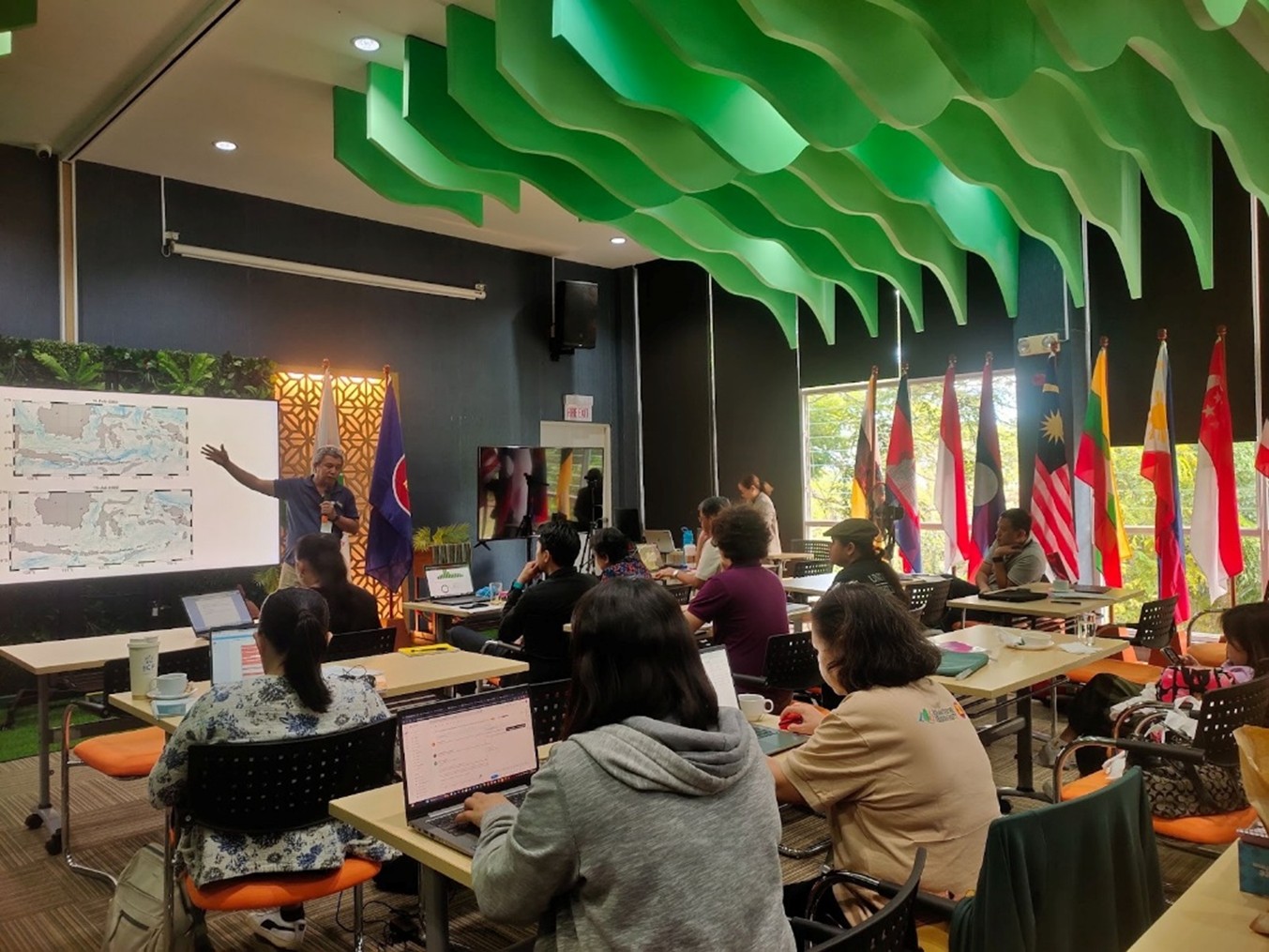
Los Baños, Laguna, Philippines — The ASEAN Centre for Biodiversity (ACB), through the project Effectively Managing Networks of Marine Protected Areas in Large Marine Ecosystems in the ASEAN Region (ASEAN ENMAPS) convened a two-day Mappers Meeting on 25–26 March 2026 at its headquarters in Los Baños, marking a key milestone in the implementation of the ASEAN ENMAPS Project. The activity serves as a critical preparatory step toward the upcoming Regional Workshop on Marine Protected Area (MPA) Network Design and contributes to the completion of Component 1 of the project.
Component 1 focuses on establishing the scientific and technical foundations for ecologically connected and socially responsive MPA networks across ASEAN Large Marine Ecosystems. The Mappers Meeting brought together GIS experts, technical consultants, and project staff to consolidate, standardise, and harmonise diverse datasets generated throughout project implementation.
This mapping phase represents a vital bridge between scientific outputs—such as connectivity modeling, biodiversity assessments, and perception mapping—and practical spatial planning for MPA networks and marine corridors.
Participants worked collaboratively to:
- Review and consolidate ecological, socio-economic, and governance datasets;
- Harmonize geospatial formats and resolve data inconsistencies;
- Translate scientific and stakeholder-derived information into usable spatial layers; and
- Prepare preliminary map outputs to support participatory MPA network design.
The meeting also marked a strategic transition from Component 1 (science generation) to Component 2, which focuses on the implementation of MPA networks, Integrated Coastal Management (ICM), Marine Spatial Planning (MSP), and Ecosystem Approach to Fisheries Management (EAFM).
A Unified Geospatial Framework for MPA Network Design
A key outcome of the meeting was the agreement on a comprehensive, multi-layered geospatial framework integrating ecological, social, and governance dimensions. This framework will guide subsequent analyses and inform MPA network design across the region.
The agreed data layers include:
- Foundational Layers: Base maps and administrative boundaries to provide spatial and jurisdictional context;
- Ecological and Habitat Layers: Maps of coral reefs, seagrasses, mangroves, and other coastal habitats to define the biophysical foundation of the network;
- Protected Areas and Conservation Layers: Existing protected areas, ASEAN Heritage Parks, and Other Effective Area-Based Conservation Measures (OECMs), followed by connectivity models and network configurations;
- Biodiversity and Species Layers: Marine Key Biodiversity Areas (KBAs) and species distribution data to identify ecological hotspots;
- Socio-Economic and Stakeholder Layers: Perception maps capturing local knowledge, resource use, and community priorities;
- Human Use and Pressure Layers: Data from Global Fishing Watch to assess fishing pressure, vessel activity, and enforcement gaps; and
- Fisheries and Productivity Layer: Catch Per Unit Effort (CPUE) data to inform fisheries sustainability and MPA effectiveness.
Integrating Science, People, and Governance
The agreed data architecture reflects a holistic design framework, where ecological connectivity—such as larval dispersal and source–sink dynamics—forms the backbone of MPA network design. Habitat and biodiversity layers define ecological value, while human use and perception data ensure social acceptability and equity. Governance layers provide the basis for implementation, and fisheries and pressure data ground decisions in real-world resource dynamics.
This integrated approach underscores that effective MPA networks must go beyond isolated ecological data, combining science, stakeholder perspectives, and governance considerations into a unified spatial decision-making system.
Moving Toward Regional Implementation
The Mappers Meeting successfully established a shared geospatial framework and common understanding of required datasets, enabling standardized and interoperable data, evidence-based spatial planning, and the integration of ecological, social, and governance considerations.
These outputs pave the way for the development of preliminary MPA network configurations and position the ASEAN ENMAPS Project to advance into participatory network design, national validation, and eventual implementation.
The next major milestone is the Regional Workshop on MPA Network Design, scheduled on 4–5 May 2026, which will further refine spatial plans and engage ASEAN Member States in collaborative decision-making.
Through these efforts, ASEAN ENMAPS continues to strengthen regional cooperation in marine conservation, ensuring that MPA networks are not only scientifically robust, but also socially inclusive and operationally feasible.
