
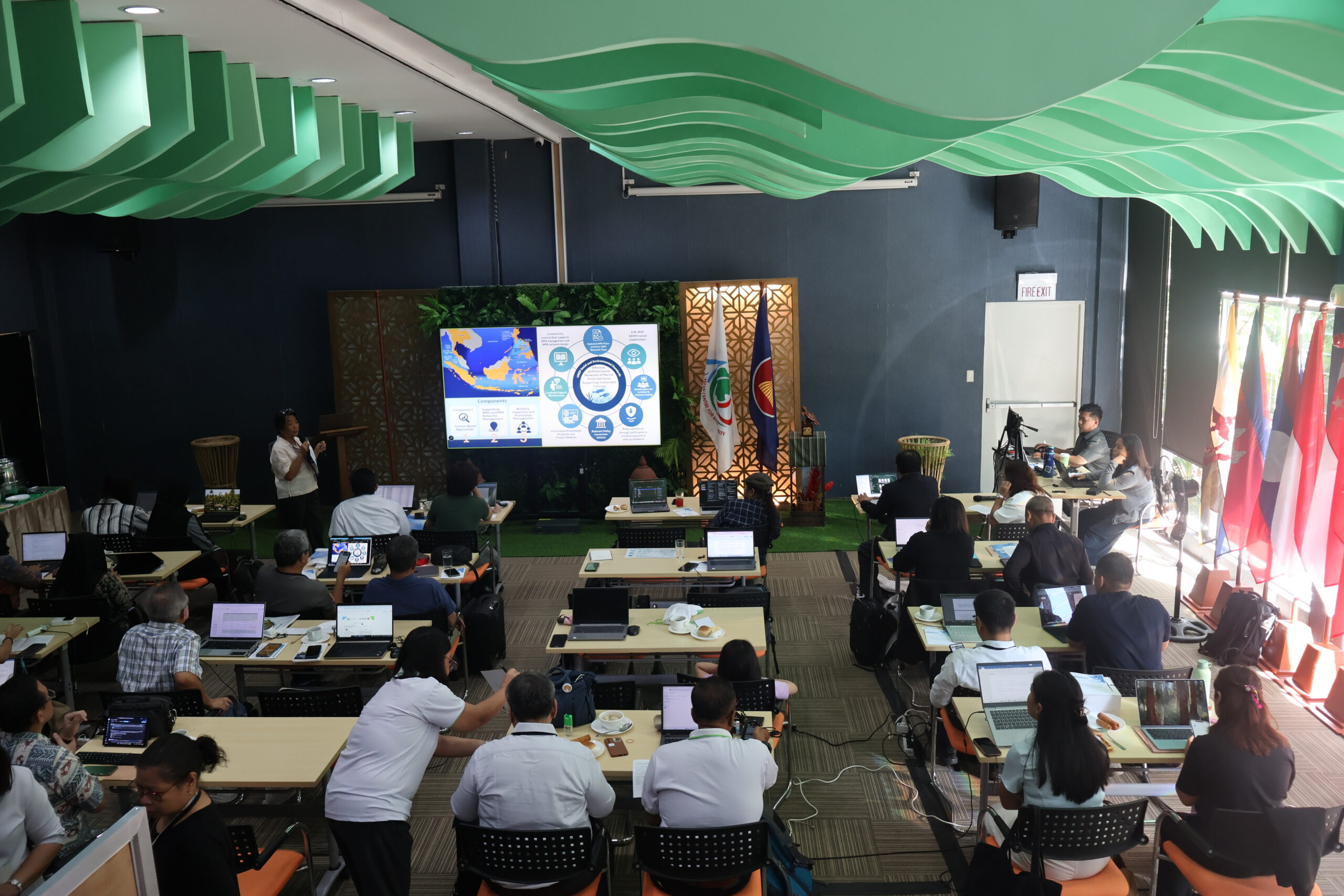
LAGUNA, Philippines — The ASEAN Centre for Biodiversity (ACB), through the Effectively Managing Networks of Marine Protected Areas in Large Marine Ecosystems in the ASEAN Region (ASEAN ENMAPS) project, is set to host a Regional Workshop on Marine Protected Area (MPA) Network Design from 4 to 5 May 2026 at the ACB Headquarters. The workshop marks a critical step in advancing science-based, regionally coherent MPA networks across ASEAN’s Large Marine Ecosystems (LMEs).
From Science to Practice
“The ASEAN ENMAPS Project has reached a critical juncture where multiple layers of scientific and governance data, ranging from larval connectivity models and species datasets to social perception mapping and institutional assessments, must be integrated. This workshop will turn datasets into spatial ‘blue prints’ for creating ecologically connected, socially sensible and nationally relevant MPA networks,” said Dr. Sheila G. Vergara, Project Manager and Chief Technical Adviser of the ASEAN ENMAPS. “The workshop will serve as a decision-oriented platform to translate scientific evidence into practical management options, bridging the gap between research outputs and implementation under Component 2 of ENMAPS, which focuses on improved MPA management and livelihood support for affected communities,” she continued.
The event brings together over 20 scientific experts, consultants, and representatives of national implementation units from Indonesia, the Philippines, and Thailand.
Over the course of the sessions, participants will examine fisheries connectivity and larval dispersal models, alongside socioeconomic and governance assessments that highlight institutional arrangements and financing mechanisms for MPA networks. During the workshop, strategic environmental and social safeguards will also be discussed to ensure that ecological priorities are balanced with community needs. Another key focus will be integrating the datasets into geospatial maps, allowing scientific and stakeholder information to be consolidated into practical planning tools. Finally, national breakout groups will engage in blueprint design workshops, applying these integrated insights to develop preliminary configurations of MPA networks that can guide future implementation.
Commitment to Collaborative Marine Conservation
The workshop underscores ASEAN’s commitment to collaborative marine conservation. By anchoring deliberations on scientific evidence and stakeholder perspectives, the initiative aims to ensure that proposed MPA networks are not only scientifically defensible but also socially owned and positioned for adoption within national policies and marine spatial planning processes.
As Dr. Jerome L. Montemayor, ACB Executive Director emphasised in his opening remarks, “This is not a task that can be accomplished by any single discipline or institution alone. It requires collaboration—across science, policy, and practice. It requires that we engage in a process of co-interpretation, where evidence is examined collectively, assumptions are tested, and trade-offs are openly discussed.”
The ASEAN ENMAPS Project is a regional initiative designed to enhance the management of networks of marine protected areas and marine corridors within selected LMEs in the ASEAN Region. It has 11 pilot sites in the participating countries of Indonesia, Thailand, and the Philippines. ASEAN ENMAPS is implemented by the United Nations Development Programme through the funding of the Global Environment Facility, and with the ACB as the executing agency.
